

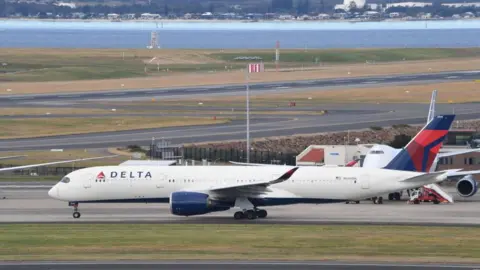
A number of individuals have been injured when a Delta Airlines flight originating in LA to Sydney, Australia experienced turbulence on Friday morning.
The flight, numbered 41 "went through a short bout of rough air" as it made its approach and landed at Sydney Airport, an airline spokesperson informed. Several cabin crew members sustained injuries.
Local paramedics stated they assessed five patients, and took three of them to a medical facility with non-life-threatening injuries that comprised spinal discomfort and head pain. The patients' ages were between their 30s up to the 70s.
It is the most recent case of aircraft experiencing severe turbulence, with experts indicating that global warming is a significant contributor.
The aircraft was carrying nearly 250 travelers and fifteen staff members on the wide-body jet, the representative added, stating that the plane landed "safely and normally" at the airport at shortly before 7 a.m. on Friday.
Emergency responders said they got a call just three minutes prior to the plane touched down, and emergency vehicles were standing by on the runway.
Why plane turbulence is becoming increasingly prevalent - and more severe.
During the past year, two dozen individuals sustained injuries when another Delta jet, travelling from Salt Lake City, Utah to Amsterdam, Netherlands, hit "severe" rough air just two hours into the transoceanic journey, and diverted for an unscheduled landing.
In 2024, travelers and staff on a certain international flight went through a frightening short but intense of severe turbulence. An individual died and numerous people sustained injuries, as those without seatbelts were thrown from their seats and crashed back down.
Bumpy air is a common occurrence during flights, and while occurrences of rough conditions seem to be rising, they are statistically infrequent.
Data suggests that there are approximately five thousand cases of significant in-flight disturbance every year, out of a sum of more than 35 million flights that now take off around the world.
Severe turbulence is described as when the up and down movements of a plane passing through rough air masses generate in excess of 1.5 times the force of gravity on your body - sufficient force to lift you out of your seat if you weren't wearing a safety belt.
As climate change alters atmospheric conditions, experts warn that commercial aviation could become more turbulent: warming trends and shifting wind patterns in the upper atmosphere are projected to boost the occurrence and strength of significant turbulence.


